

Anand Systems Engineering unveils AI crane safety system
Tue, 24th Nov 2026 (Today)
Anand Systems Engineering has built an AI human detection system for overhead cranes, which is operating on a working crane at a steel plant in Pune.
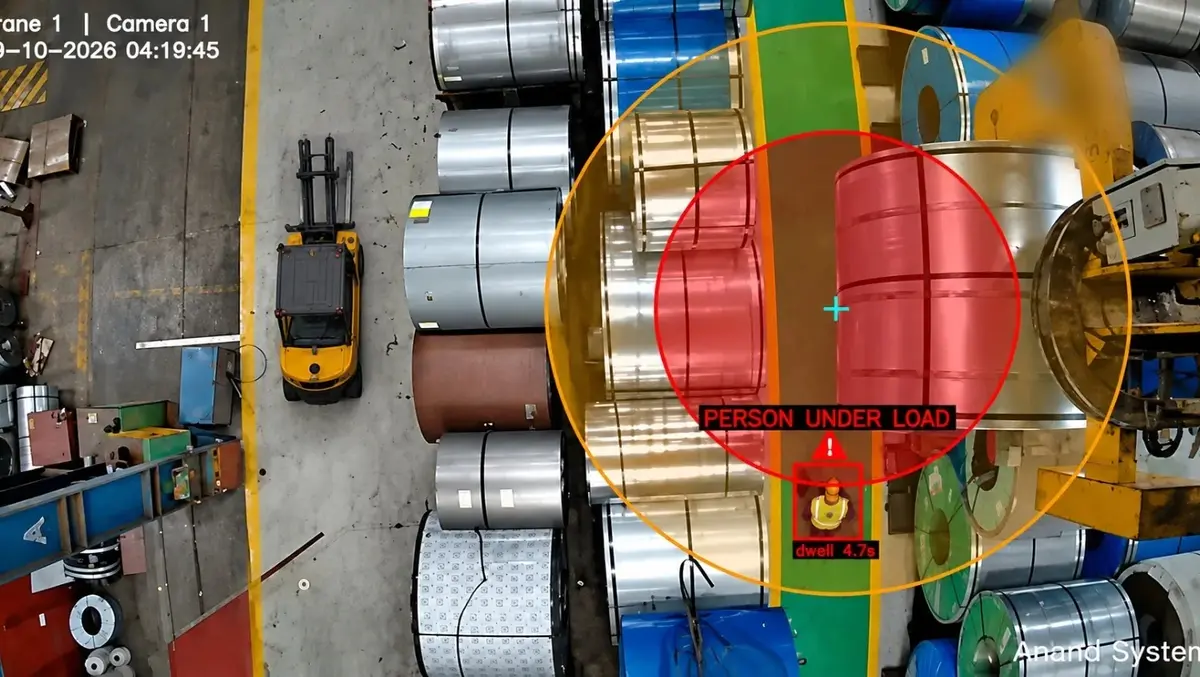
The Mumbai-based manufacturer said the technology monitors the floor beneath a crane's load and raises an alarm when a person enters a defined risk area. It is designed for environments such as steel plants, warehouses, foundries and fabrication shops, where workers can move into blind spots below suspended loads.
The company has made electrical parts for EOT cranes since 2007. It said crane operators often cannot see the floor directly beneath a moving load because coils, machinery and the load itself block the view from the cabin. The new system is intended to provide a direct warning on the crane, rather than rely only on floor markings, permits or visual observation.
"Every lift should end with everyone going home," said Rohit Dewani, Director, Anand Systems Engineering.
"Crane operators cannot see everything under the load. Painted walkways and permits depend on every person remembering, every shift, every lift. A camera does not forget to look, so we built a system that watches the floor for the operator and warns everyone before the load reaches a person," Dewani said.
Overhead view
Standard person-detection AI is commonly trained on images captured at eye level, where a worker's face and full body outline are visible, Anand Systems Engineering said. A camera mounted high on a crane instead looks straight down, reducing a person to a much smaller overhead shape and creating confusion with industrial objects on the floor.
To address that, the company trained its model on 28,835 images gathered from cameras mounted on working cranes at a steel plant. The training set also included lookalike objects such as buckets, ladders and cable coils to reduce false alarms, it said, and the model can identify workers who are only partly visible between stacks.
"The first thing we learned on site was that the AI everyone uses was looking for faces and legs, and a crane camera sees neither," Dewani said.
"We had to teach a model what a person looks like from twenty metres above, on a real shop floor, in real light. That is why we collected our own overhead images from working cranes instead of starting from a public dataset," he said.
On-crane processing
The setup uses two industrial PoE cameras mounted on the crane, with an option for a third camera in wider bays. The AI model runs inside a lockable steel panel mounted on the crane, so detection does not rely on an internet connection.
According to the company, the system identifies the crane hook and keeps two circular zones centred on the load as the crane moves. It tracks each person in view separately and assigns each one an individual dwell timer, including when several workers move through an area at the same time.
When someone enters a zone, the system switches on a warning light and an industrial hooter. A relay contact can also be used to slow or stop the crane. The response takes place in less than one second, the company said. Settings such as zone size, thresholds and outputs can be configured for each site.
A browser-based dashboard provides live camera views, alert history with snapshots and zone settings, while each event is logged with its time and dwell duration for safety review. Alerts continue on the crane if the network connection fails, with data synchronised once connectivity returns, the company said. The system also restarts automatically after a power cut.
"A safety system that needs a perfect network or a person watching a screen will fail exactly when it is needed," Dewani said.
"So the decision is made on the crane, in under a second, and the warning goes to the people on the floor, not to an office," he said.
Industrial market
The company said the system can be used on single and double girder EOT cranes, as well as gantry and semi-gantry cranes, with hook heights ranging from 5 to 20 metres. Before deployment, the model is adjusted during commissioning using images from a customer's own cranes, lighting conditions and materials.
Anand Systems Engineering is also surveying potential use in warehouses and stockyards, foundries and forging shops, fabrication bays, power plant maintenance bays and heavy-lift yards. The move marks an expansion from the company's established business making components including busbar systems, radio remote controls, thruster brakes, limit switches, master controllers and pendant stations.
"We have made crane parts for almost twenty years: busbars, brakes, limit switches, radio remotes," Dewani said.
"Those parts make a crane move. This is the first product we have made that watches the people around it. Plants already have cameras and safety rules. What they have not had is something on the crane itself that sees the person the operator cannot," he said.